Psalm 139 · Overview
The Architecture of the Poem
Psalm 139 · Overview
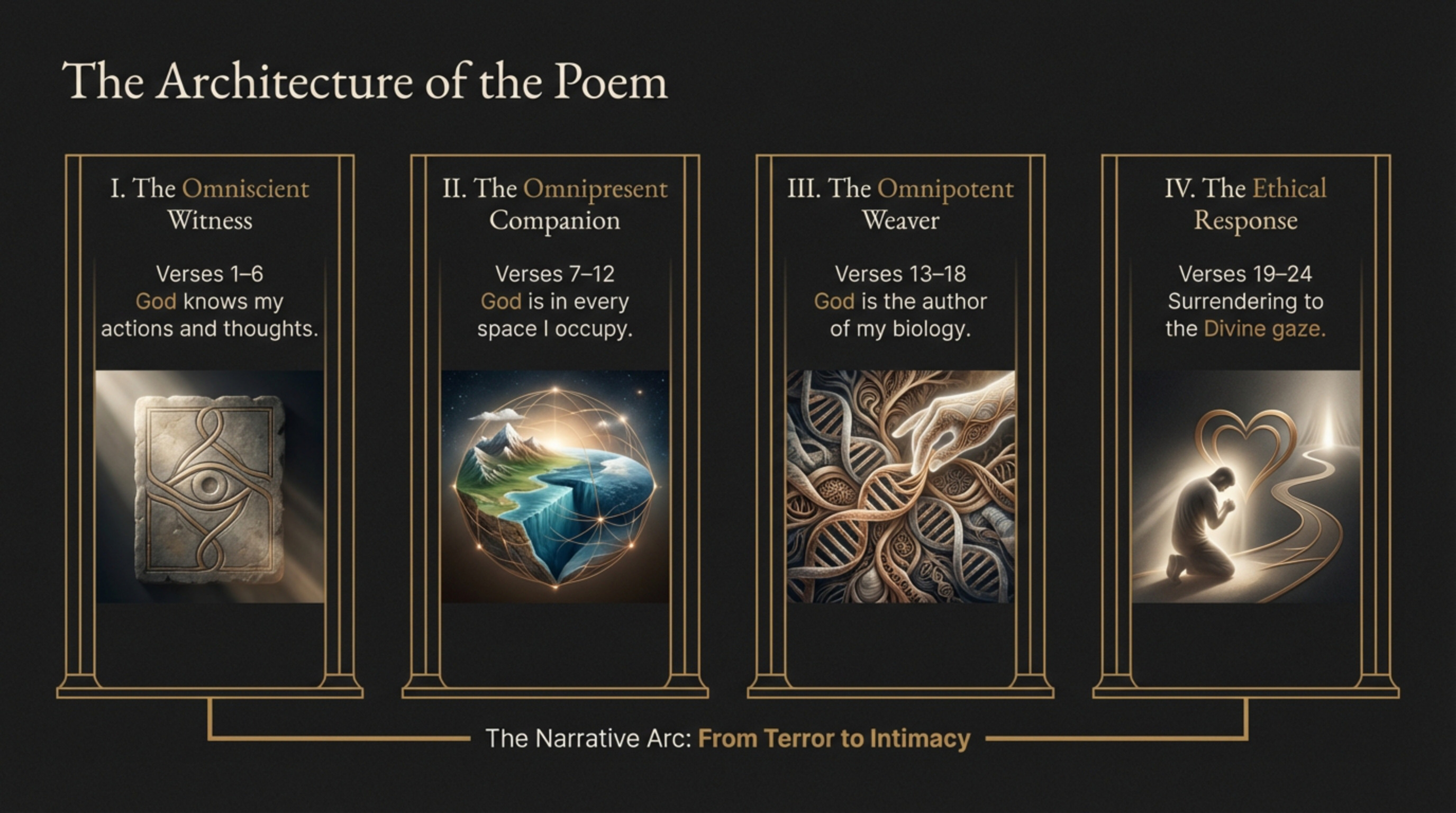
The Architecture of the Poem
Four symphonic movements — each revealing God. The arc: from terror to intimacy.
Psalm 139 moves in four symphonic movements — each revealing a different dimension of God's nature. The arc of the whole: from terror to intimacy. To be fully known by a Holy God is first frightening — and then becomes the most liberating truth in existence.
L&L
Movement I · vv. 1–2
Psalm 139:1–2
"O LORD, you have searched me and you know me. You know when I sit and when I rise; you perceive my thoughts from afar."
Psalm 139:1–2 · ESV
The Merism of Motion
Psalm 139:1–2
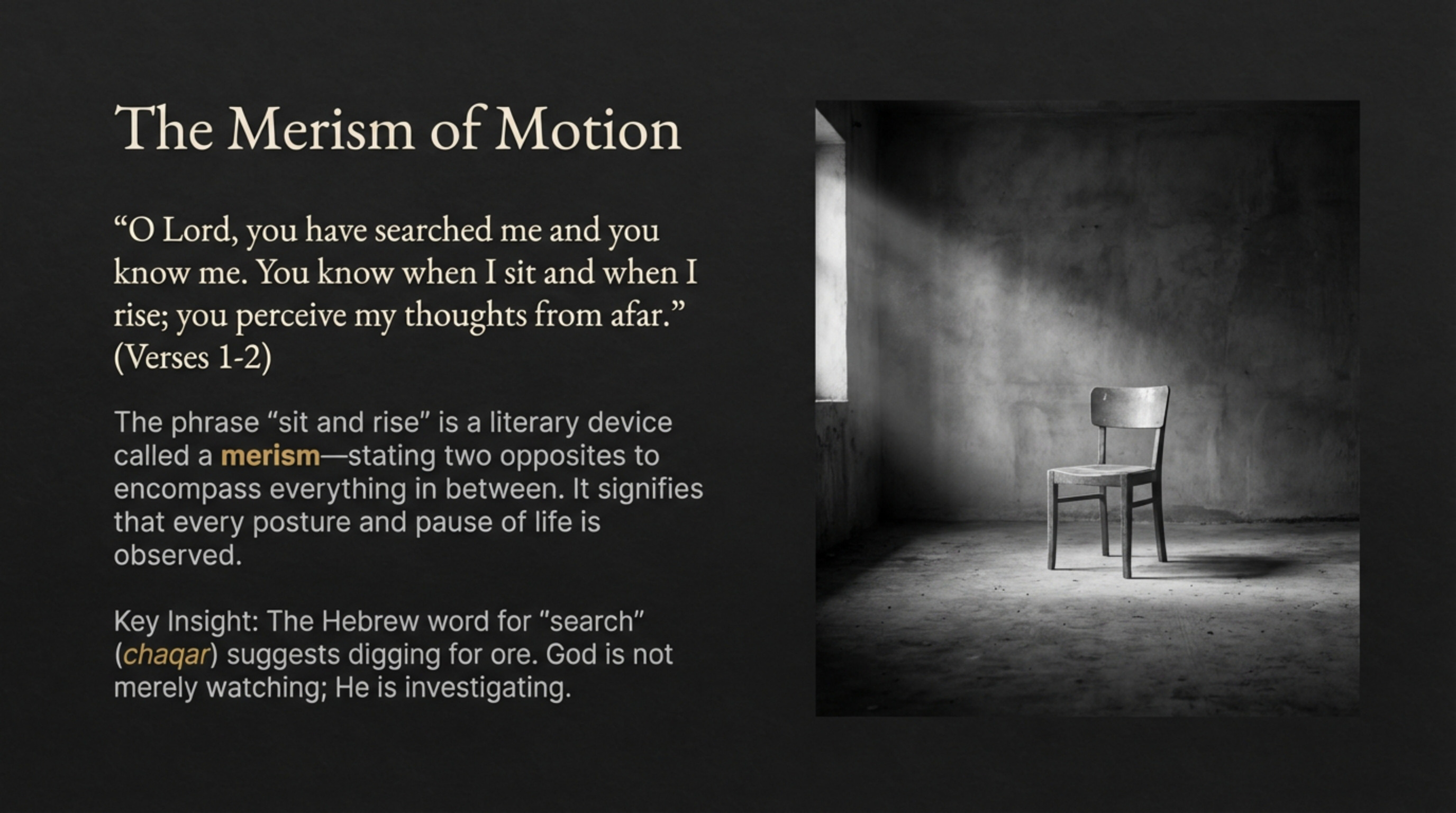
The Merism of Motion
"You have searched me and know me." Hebrew: chaqar — to dig for ore. God excavates, not glances.
The Hebrew word for "searched" (chaqar) is an archaeological term — it means to dig for ore. God is not glancing at the surface of a life. He excavates. "Sit and rise" is a merism — two opposites that together encompass everything in between. Every posture. Every pause.
L&L
Movement I · vv. 3–4
Psalm 139:3–4
"You discern my going out and my lying down; you are familiar with all my ways. Before a word is on my tongue you, LORD, know it completely."
Psalm 139:3–4 · NIV
Winnowing the Path
Psalm 139:3–4
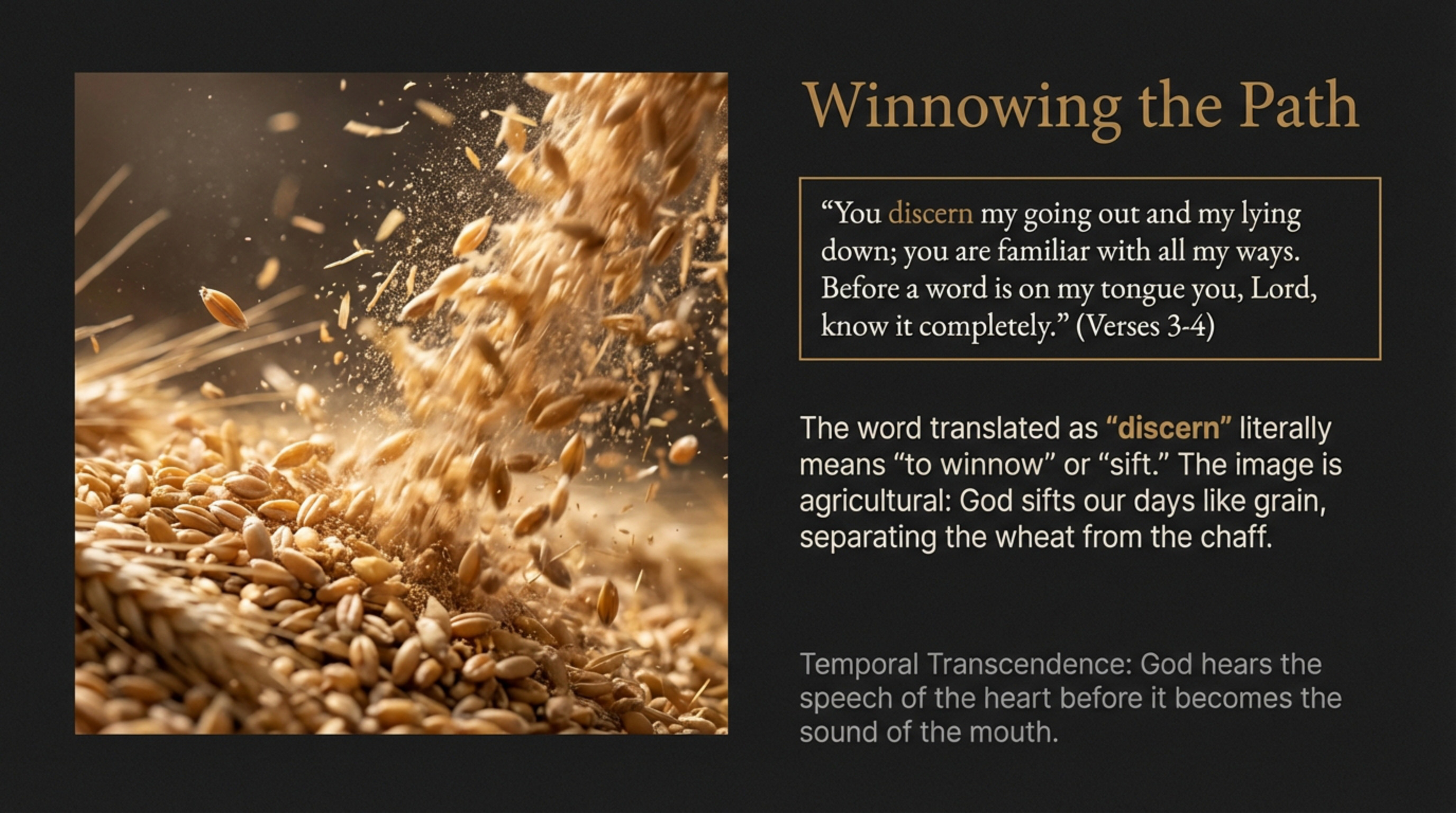
Winnowing the Path
"Before a word is on my tongue you, LORD, know it completely."
"Discern" literally means to winnow — to sift grain, separating wheat from chaff. God sifts our days. And then verse 4: before the word forms on the tongue, God has already heard the heart speak it. Temporal transcendence — presence that precedes the moment.
L&L
Movement I · vv. 5–6
Psalm 139:5–6
"You hem me in behind and before, and you lay your hand upon me. Such knowledge is too wonderful for me, too lofty for me to attain."
Psalm 139:5–6 · NIV
The Claustrophobia of the Divine
Psalm 139:5–6
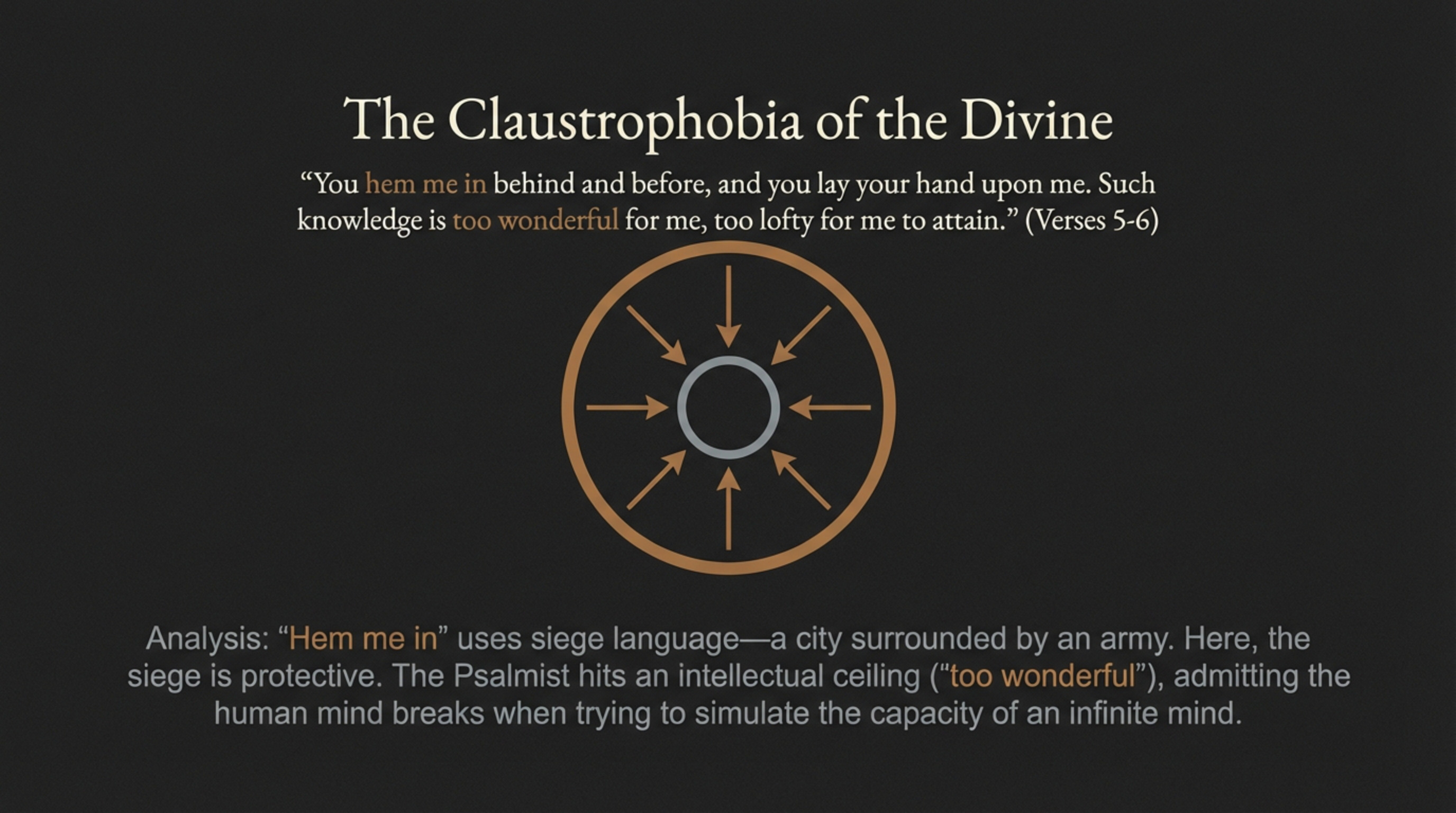
The Claustrophobia of the Divine
"You hem me in behind and before." Siege language — but the army is grace, not threat.
"Hem me in" uses siege language — a city surrounded on all sides. But the army here is grace, not threat. The same word for enemy encirclement describes God's encompassing presence. At verse 6, David hits the ceiling: "too wonderful." The human mind breaks when it tries to simulate infinite knowledge.
L&L
Movement II · vv. 7–8
Movement II of IV
The Omnipresent Companion
"God is in every space I occupy"
Psalm 139:7–8
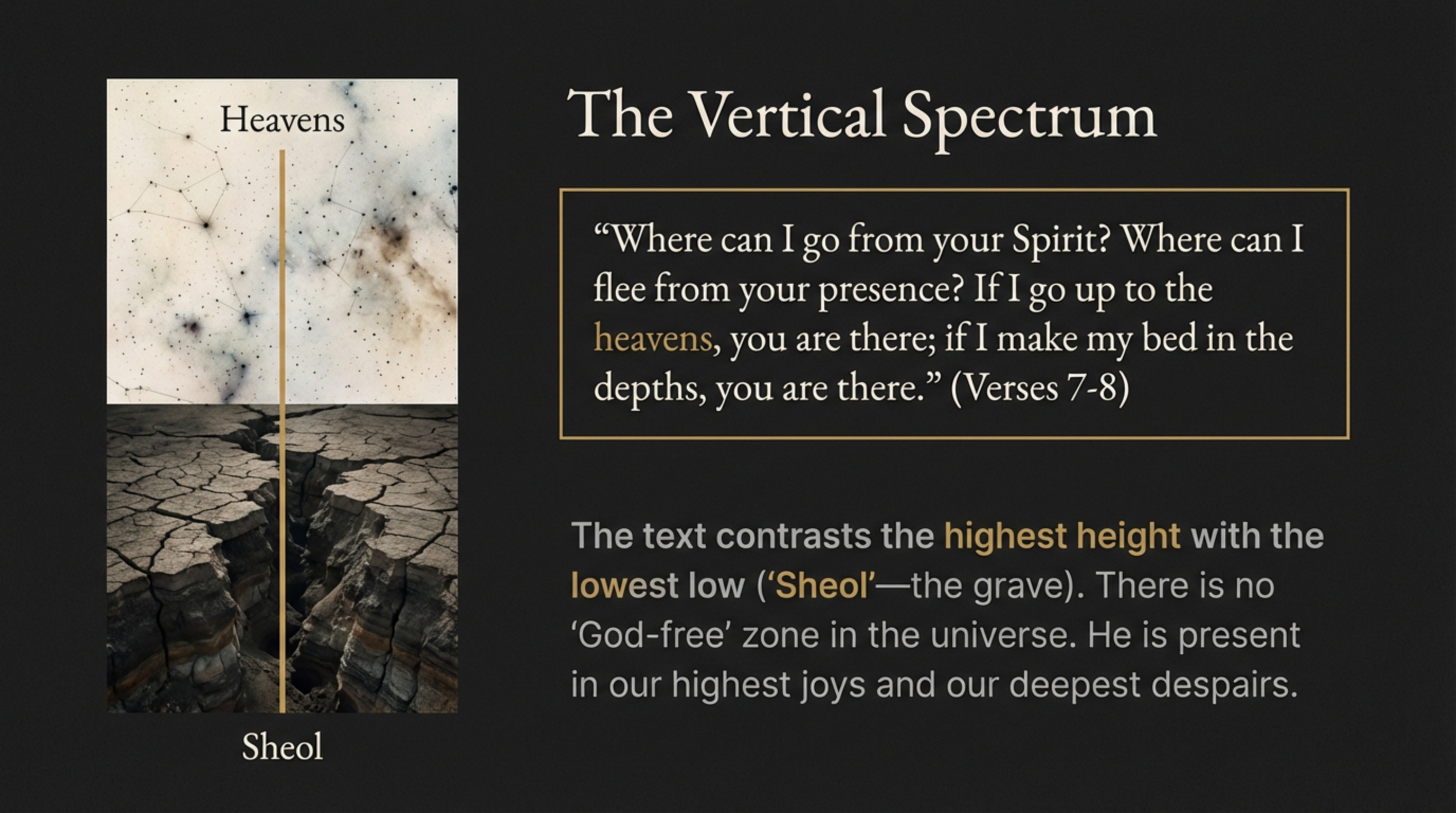
"Where can I go from your Spirit? Where can I flee from your presence? If I go up to the heavens, you are there; if I make my bed in the depths, you are there."
Psalm 139:7–8 · NIV
The Vertical Spectrum
Psalm 139:7–8
The Vertical Spectrum
"If I make my bed in the depths, you are there." No God-free zone exists.
The highest height versus Sheol — the grave, the lowest conceivable low. No God-free zone exists in the universe. David begins trying to flee — and ends discovering he is accompanied. God is present in the highest joy and the deepest despair.
L&L
Movement II · vv. 9–10
Psalm 139:9–10
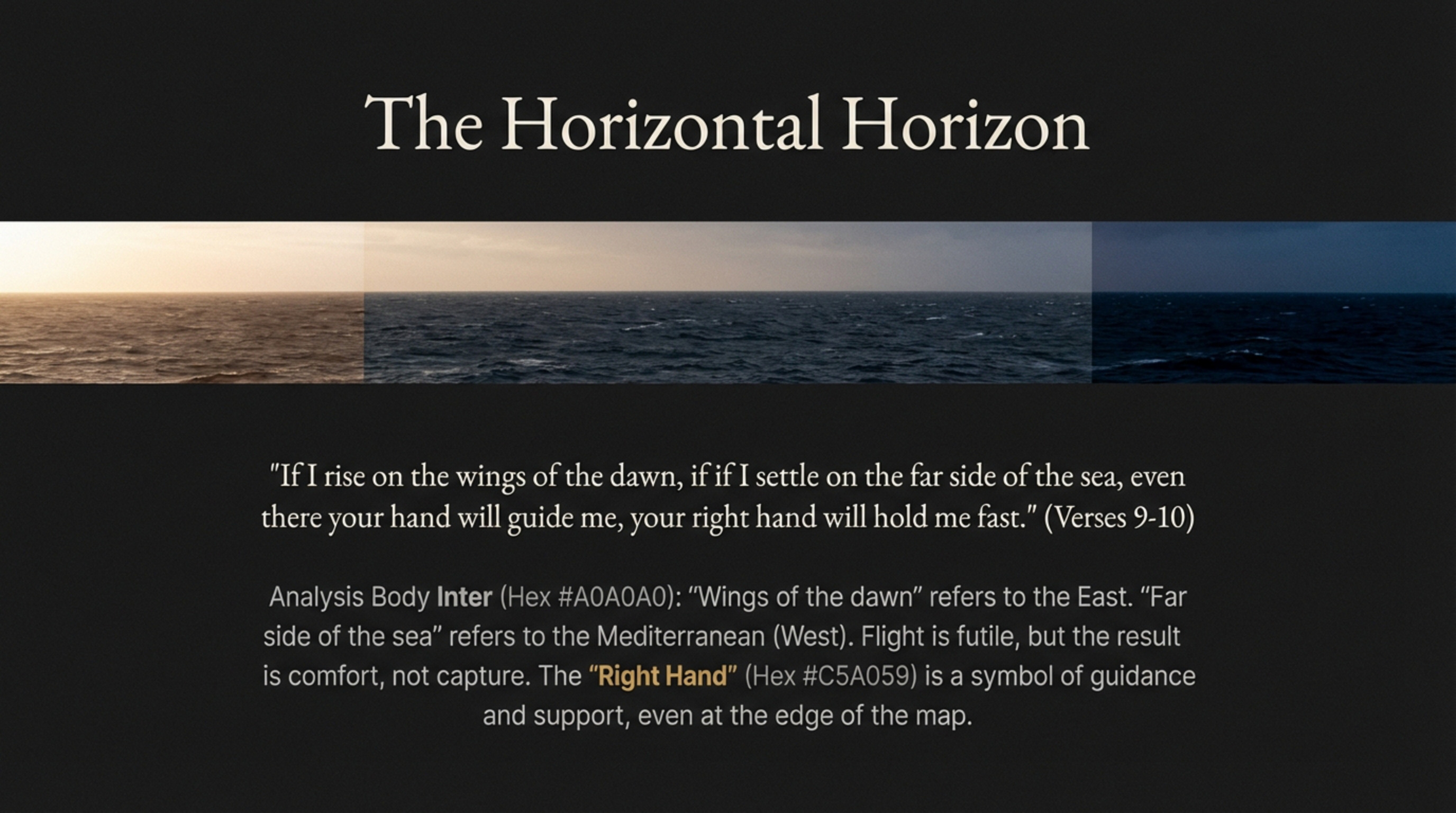
"If I rise on the wings of the dawn, if I settle on the far side of the sea, even there your hand will guide me, your right hand will hold me fast."
Psalm 139:9–10 · NIV
The Horizontal Horizon
Psalm 139:9–10
The Horizontal Horizon
"Your right hand will hold me fast." At the farthest edge — not a fist. An open palm.
"Wings of the dawn" = the East. "Far side of the sea" = the West. Every compass direction covered. Flight is futile — but notice what follows: not capture. Guidance. Holding. The hand of God at the farthest edge of the map is not a fist. It is an open palm.
L&L
Movement II · vv. 11–12
Psalm 139:11–12
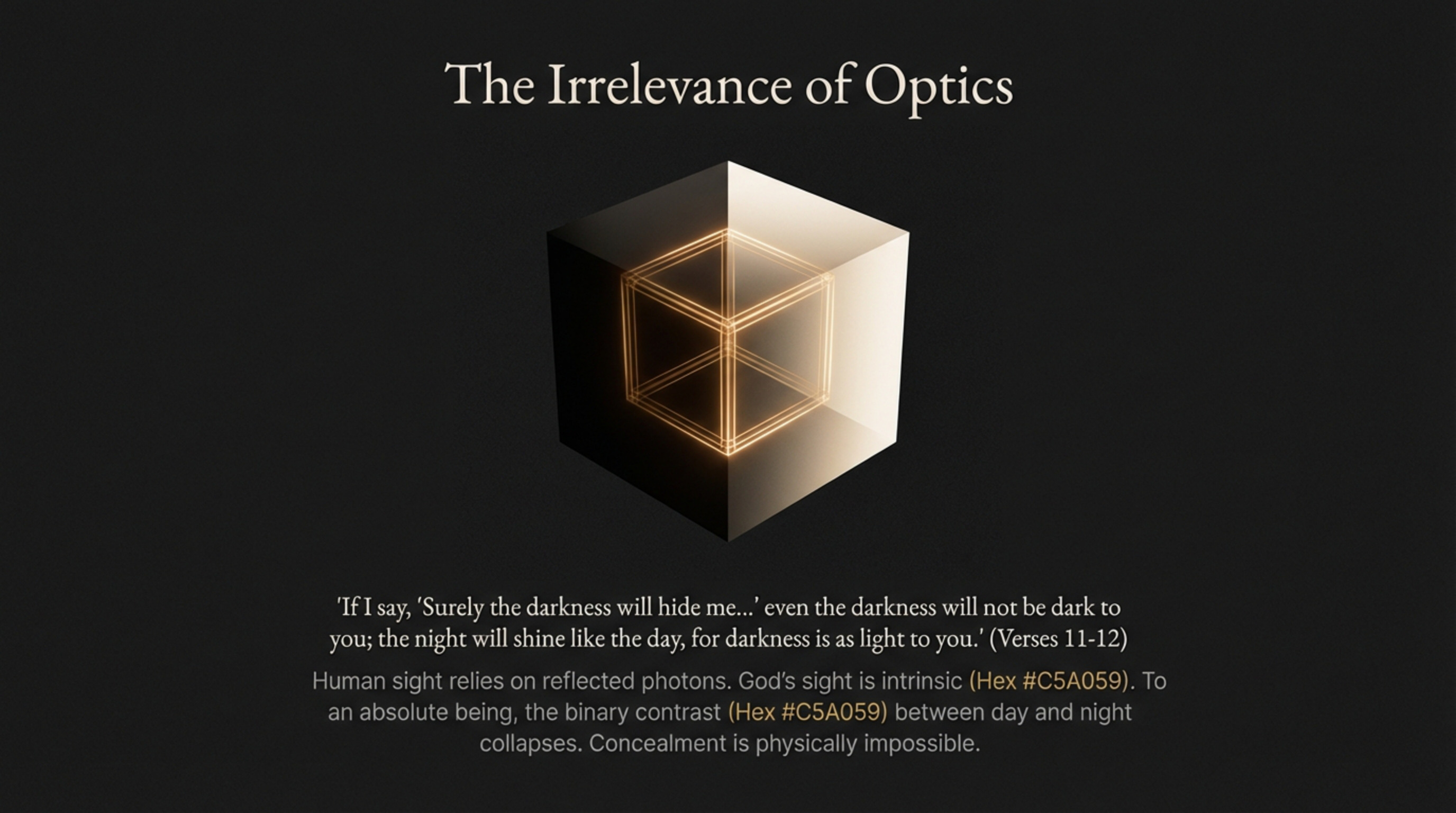
"If I say, 'Surely the darkness will hide me'… even the darkness will not be dark to you; the night will shine like the day, for darkness is as light to you."
Psalm 139:11–12 · NIV
The Irrelevance of Optics
Psalm 139:11–12
The Irrelevance of Optics
"Even the darkness will not be dark to you — darkness is as light to you."
Human sight depends on reflected photons. God's sight is intrinsic. The distinction between day and night — the most fundamental binary contrast in nature — collapses before him. Concealment is not merely difficult. It is physically impossible. There is no shadow deep enough.
L&L
Movement III · vv. 13–14
Movement III of IV
The Omnipotent Weaver
"God is the author of my biology"
Psalm 139:13–14
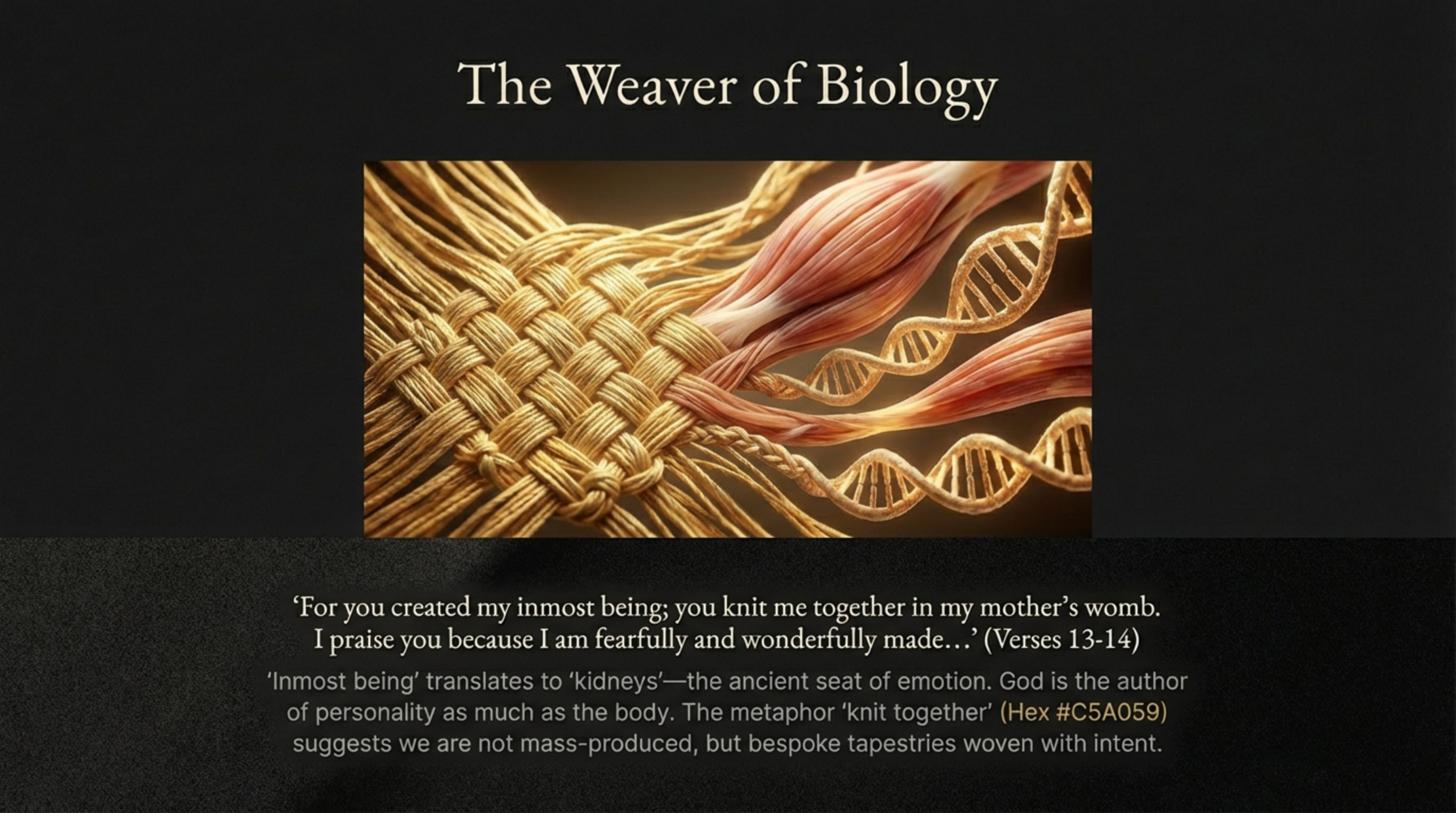
"For you created my inmost being; you knit me together in my mother's womb. I praise you because I am fearfully and wonderfully made…"
Psalm 139:13–14 · NIV
The Weaver of Biology
Psalm 139:13–14
The Weaver of Biology
"I am fearfully and wonderfully made." Not mass-produced — a bespoke tapestry.
"Inmost being" translates the Hebrew word for kidneys — the ancient seat of emotion and conscience. God is the author of personality as much as the body. "Knit together" is a weaving metaphor: we are not mass-produced. We are bespoke tapestries — woven thread by thread with intent.
L&L
Movement III · vv. 15–16
Psalm 139:15–16
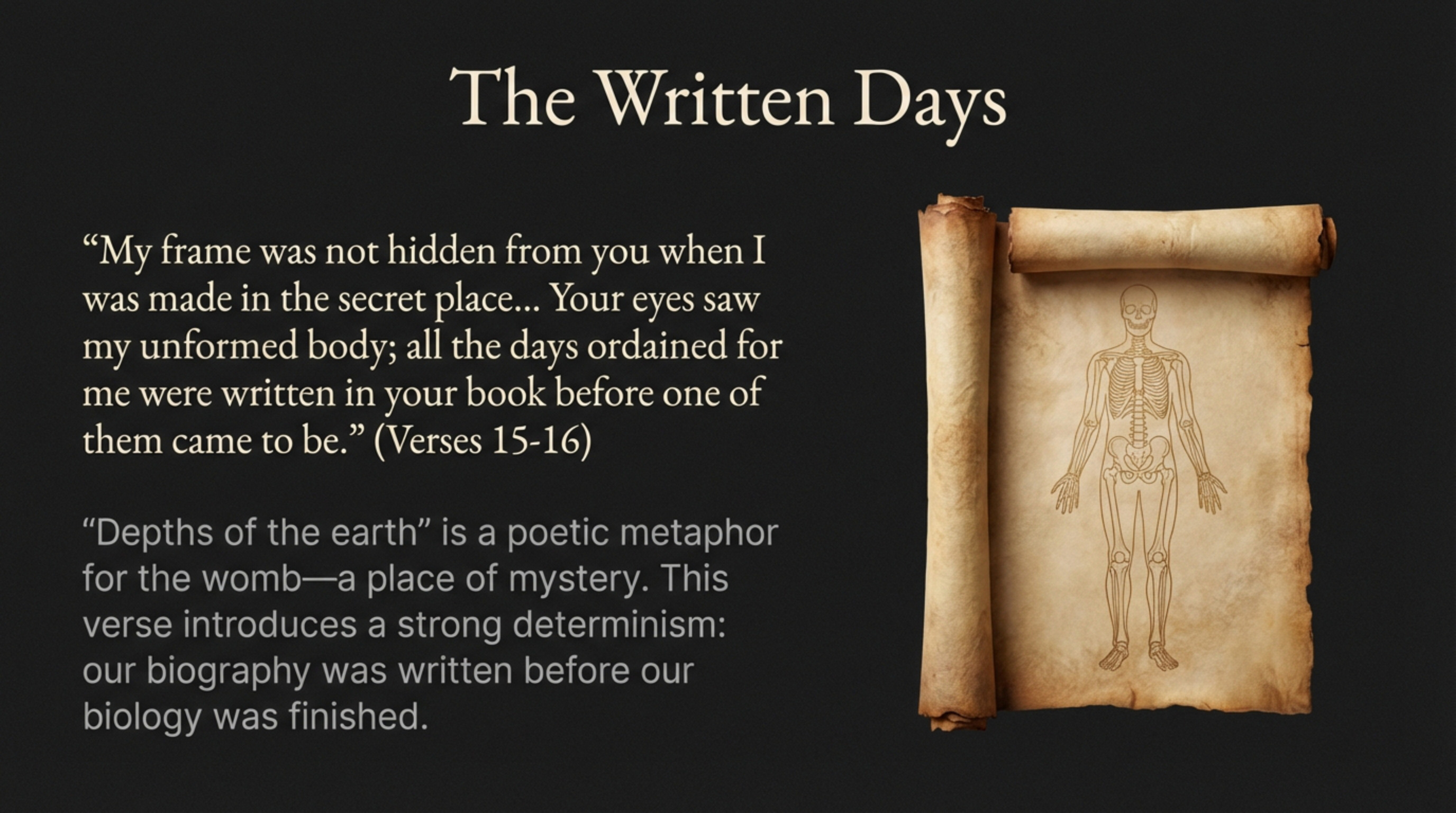
"My frame was not hidden from you… Your eyes saw my unformed body; all the days ordained for me were written in your book before one of them came to be."
Psalm 139:15–16 · NIV
The Written Days
Psalm 139:15–16
The Written Days
"All the days ordained for me were written in your book before one of them came to be."
"Depths of the earth" is a poetic metaphor for the womb — a place of mystery before light. Then verse 16: our biography was written before our biology was finished. God held the manuscript of your life before the ink of your existence was dry.
L&L
Movement III · vv. 17–18
Psalm 139:17–18
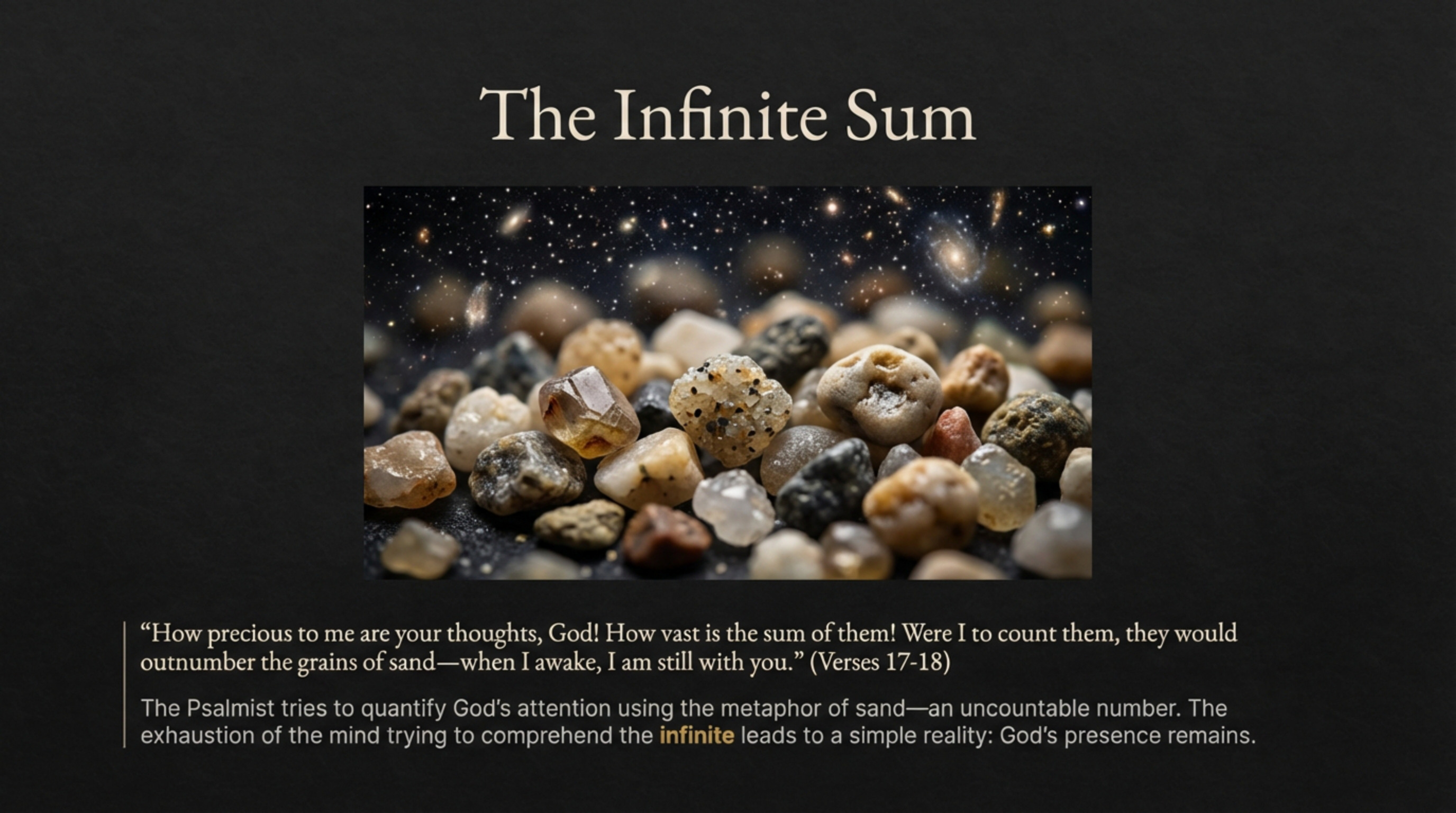
"How precious to me are your thoughts, God! How vast is the sum of them! Were I to count them, they would outnumber the grains of sand — when I awake, I am still with you."
Psalm 139:17–18 · NIV
The Infinite Sum
Psalm 139:17–18
The Infinite Sum
"When I awake, I am still with you." Infinity resolves into presence.
David reaches for the largest number he can conceive — grains of sand on every shore — and declares even that falls short. Then the most quietly stunning line in the psalm: "when I awake, I am still with you." Infinity resolves not into theology, but presence.
L&L
Movement IV · vv. 19–22
Movement IV of IV
The Ethical Response
"Surrendering to the Divine gaze"
Psalm 139:19–22
"If only you, God, would slay the wicked!… Do I not hate those who hate you, LORD? I have nothing but hatred for them; I count them my enemies."
Psalm 139:19–22 · NIV
The Recoil of Holiness
Psalm 139:19–22
The Recoil of Holiness
Standing before holiness — David gives the violence to God. This is total loyalty.
The jarring tonal shift is intentional. Standing before perfect holiness, David cannot remain neutral about evil. But he does not draw a sword — he gives the violence to God. This is total loyalty — not vengeance, but alignment with the character of a Holy God.
L&L
Movement IV · v. 23
Psalm 139:23
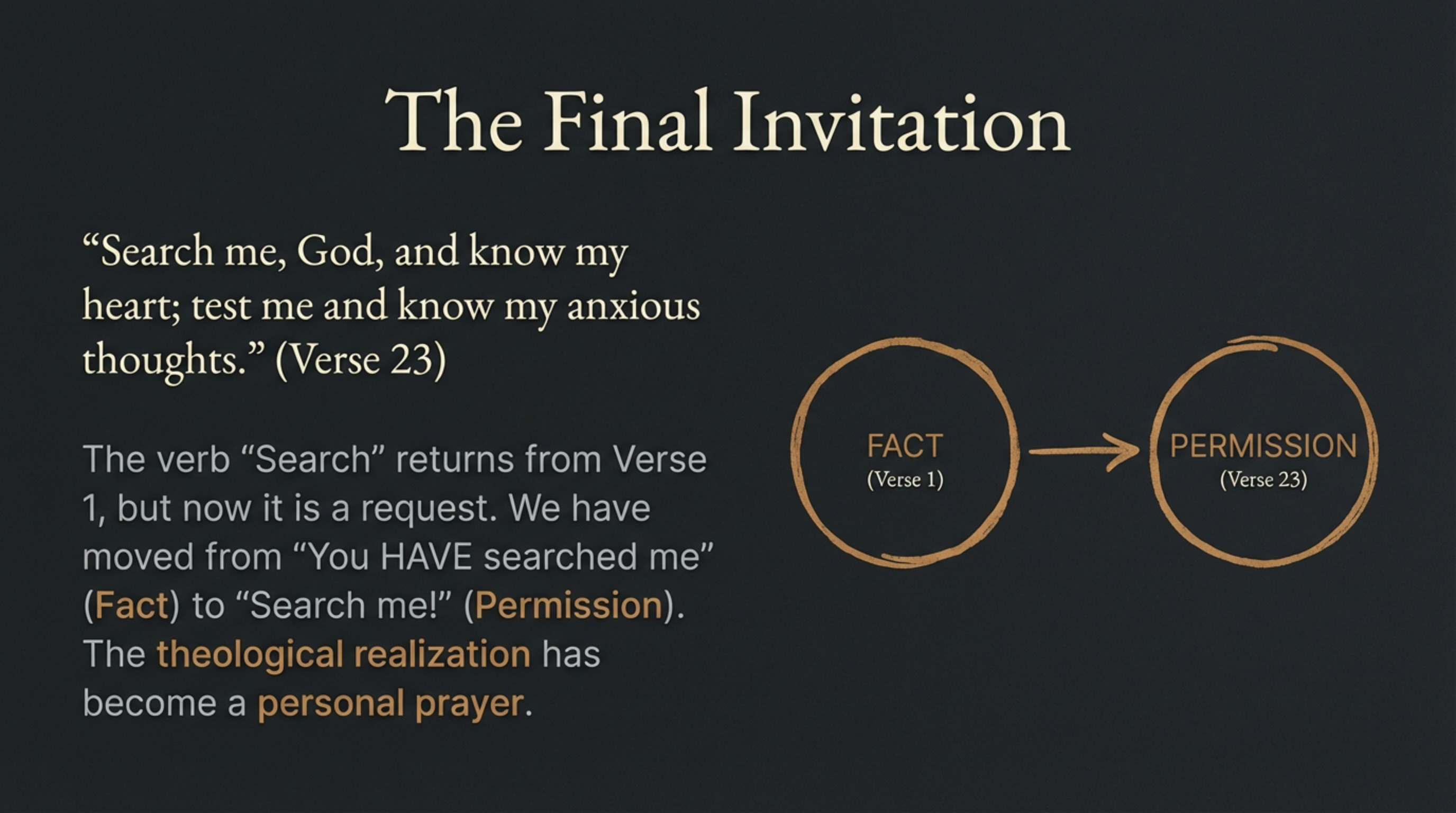
"Search me, God, and know my heart; test me and know my anxious thoughts."
Psalm 139:23 · NIV
The Final Invitation
Psalm 139:23
The Final Invitation
"Search me, God." The fact becomes a prayer. David asks for what he once could not escape.
The verb search returns from verse 1 — but everything has changed. In verse 1 it was a fact: "You have searched me." Here it is a prayer: "Search me." The theological realization has become a personal invitation. David now asks for what he once could not escape.
L&L
Movement IV · v. 24
Psalm 139:24
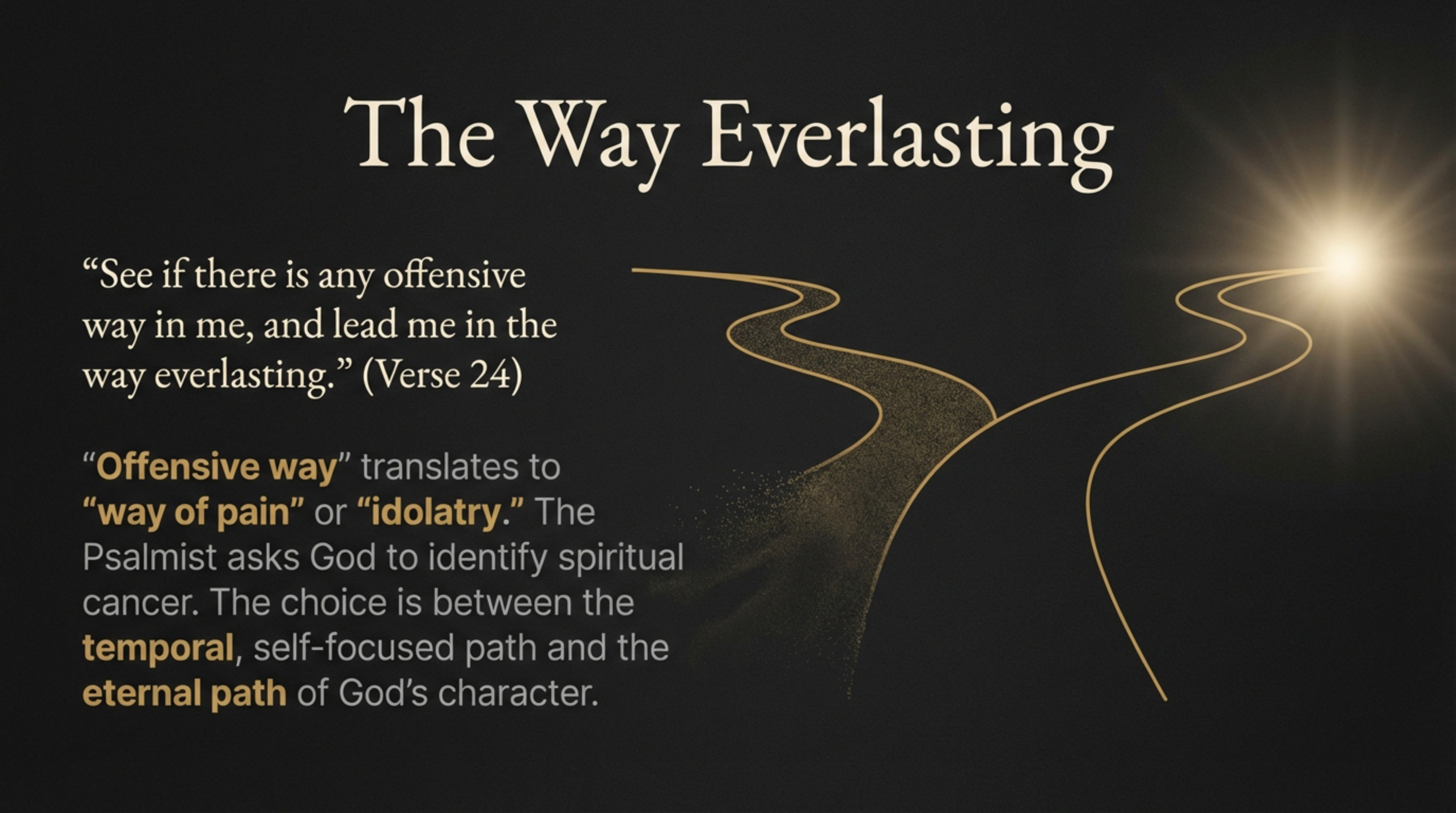
"See if there is any offensive way in me, and lead me in the way everlasting."
Psalm 139:24 · NIV
The Way Everlasting
Psalm 139:24
The Way Everlasting
"Lead me in the way everlasting." The psalm ends not with declaration, but surrender.
"Offensive way" translates literally to the way of pain or idolatry — any path that is self-sourced and self-terminated. The choice is binary: the temporal, self-focused road — or the way everlasting. The psalm ends not with a declaration, but a surrender.
L&L